

Book Recommendation #8: Procrastinate on Purpose by Rory Vaden
5 Permissions To Multiply Your Time

Welcome to "A Book A Week," where we uncover the wisdom from great books to help you elevate your life, unleash your creativity, boost productivity, and build the future you desire. Each week, I distill the most impactful ideas from the books I’m reading, curating concepts that can make a real difference when applied to your life.
Since the inception of this newsletter, I’ve delved into a wide range of topics essential to personal growth and self-mastery.
"A Book A Week" is free, but it’s fueled by the support of readers like you. If you find value in these insights, I invite you to consider subscribing and joining a community of passionate learners dedicated to optimizing their habits, routines, and overall potential.
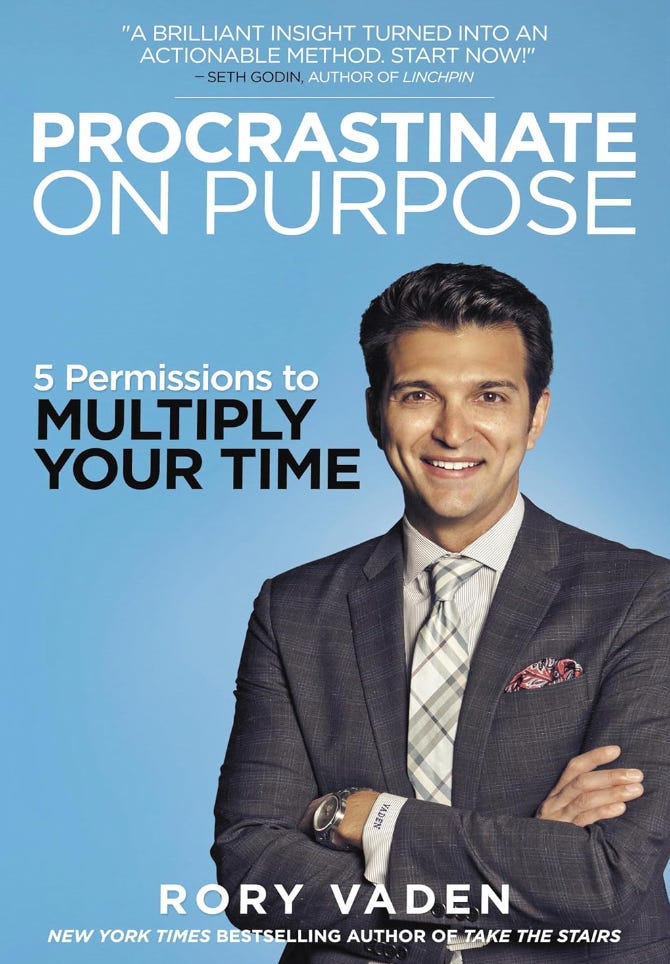
Procrastinate On Purpose, came to me as an example of how a wrong title can ruin a good book.
Rory Vaden, an author of multiple bestsellers went against the advice of experts to keep the title he choose for his book ‘Procrastinate On Purpose,’ and his book tanked.
He gave a Ted Talk on the concept and titled it ‘Multiply Your Time,’ and it went viral.
I listened to his Ted Talk and decided I need to read this book and bring it your attention. We all need to know what Rory learned from training thousands of his clients.
“Everything you know about time management is wrong.” - Rory Vaden
That’s the premise with which the book starts. Vaden makes the case that the successful people choose to spend their time differently. They are not looking at ‘saving’ time or ‘getting more done’ in less time. Instead they look at multiplying time.
When you approach time you get to play one of three roles:
Firefighter
Judge
Multiplier
More about these roles in a minute but first, if you have been serious about time management, productivity or personal development in general, you would have seen Stephen Covey's Time Management Matrix.
It's a two by two matrix showing which tasks are important, urgent, neither or both.
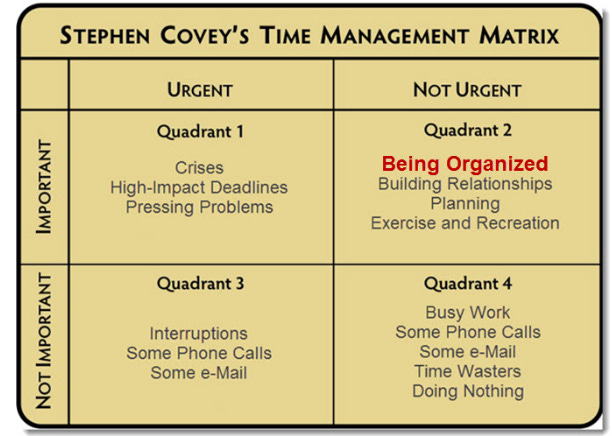
Stephen Covey’s main idea was that you want to focus on what's important instead of what's urgent, particularly those high value tasks which are often important but not urgent.
This is a good first step, because many people are the first of the three roles— firefighters. They run from one task or crisis to another, trying to get it all done, like a firefighter putting out fires.
Firefighters want to get more done. They think if they can just get more done, they'll cross everything off their to do list and they’ll ascend to the heights of success and perfect peace.
The problem here is even utilizing every life hack, productivity tip and getting things done system, there's always more to do. Firefighters are driven by urgency. They ask:
What tasks do I have to do?
And when they see the endless list of tasks they think they need efficiency.
Efficiency is important, but it is only one part of the success equation, and by itself has almost zero value.
In contrast, Covey's driving force was important, but he chose a greater question.
What tasks should I do?
This leads to the question, how do I prioritize my tasks. The answer he got was, effectiveness. Do what matters. Those who follow this principle are the second role judges. They are regularly evaluating what is important.
While firefighters chant—get more done, get more done.
The mantra of the judge is—make it count, make it count.
While Covey asked the best question, according to his two by two matrix, you have to break out of the matrix to find an even better question.
Let's talk about the third role multipliers. Multipliers are driven by significance.
That is, how can I leave the biggest impact over the longest period of time? Multipliers ask this powerful question:
What can I do today to create more time in the future?
The answer is multiplication. These Multipliers have realized that creating the next level of results requires the next level of thinking. Rather than being ‘efficient’ and ‘effective’ they looked at multiplying their time.
In summary, firefighters want to do tasks faster.
Judges want to do important tasks.
And multipliers want to create more time.
Firefighters and judges think linearly, whereas multipliers think exponentially.
How do they do that?
The way to do that is by using what Rory Vaden calls the Focus Funnel.
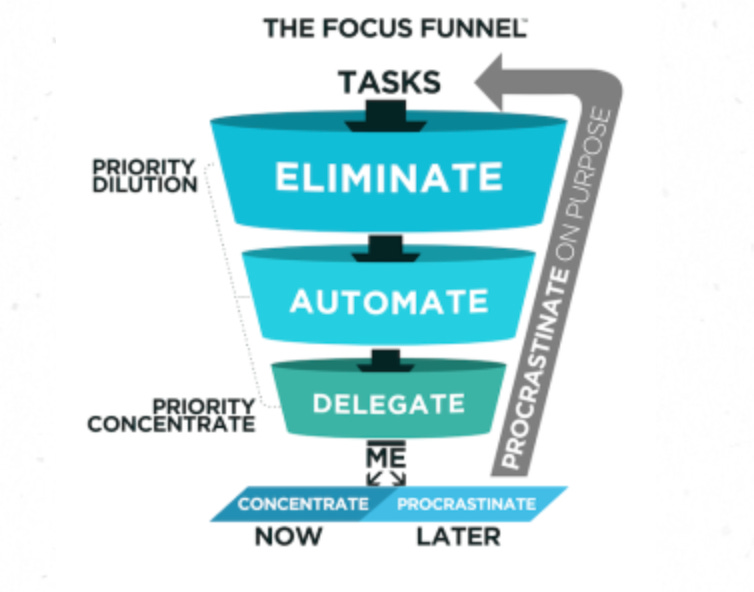
Tasks enter your focus funnel at the top and filter down. At each stage, you check if it's appropriate for the task to exit the funnel, or if it needs to continue down.
Rory takes them through 5 Permissions funnel.
Eliminate:
Get rid of unnecessary tasks and commitments that don’t add value or align with your goal. Say ‘No’ to every new task that doesn’t add value or align with your goal. There are so many things you could eliminate to instantly create more time. You need to give yourself the permission to say ‘no.’
Automate:
Do you find yourself regularly sending the same type of email, answering the same questions, or doing similar things over and over again? Automate them, create a template, create a process, find tools that do it for you, or even create your own simple tools. Set up systems and processes that run on their own, saving you time in the long run.
Delegate:
Assign tasks to others who can handle them, freeing up your time for higher priorities. It might take you longer to teach someone to do a task but in the long run you will save time. In some cases, they will do the task better than you. In other cases, they won't do it as well as you. You have to give yourself the permission of imperfect because effective leadership isn't about perfection. It's about getting things done through others.
Concentrate:
The ability to concentrate single mindedly on your most important task, to do it well and finish it completely is the key. So block out time, eliminate distractions, change your location if needed, and work on your most important task until it's done.
Procrastinate:
If your task cannot be eliminated, automated, delegated and it's not time to give it priority, then you procrastinate on purpose. You put a task on back burner when the requirements of the task keep changing, or it makes sense to wait for clarity.
Being okay with leaving some things undone is a part of multiplying time.
The critical questions are:
Are you procrastinating to do things you know you should do, but you don't want to?
Are you procrastinating on purpose?
If you’re procrastinating on purpose, you're being patient for the right time to do the task. And that saves to time having to do it all over again. Give yourself permission to procrastinate allowing you to focus on what you can accomplish now.
About the Author
Rory Vaden is a New York Times bestselling author of Take the Stairs: 7 Steps to Achieving True Success, an 8 Figure Entrepreneur (Co-founder of Brand Builders Group), and a Hall of Fame Keynote Speaker.
Rory Vaden grew up in Boulder, Colorado, a trailer park, with his mom. His parents divorced when he was young. His mother worked several jobs to support the family, which left a lasting impact on Rory and his understanding of hard work and perseverance. Rory was a self-described "fat kid" who struggled with self-esteem and body image issues during his youth. These challenges led him to develop a strong sense of discipline and a desire to improve himself, which would later fuel his passion for personal development.
During his college years at the University of Denver, Rory became heavily involved in competitive public speaking through the organization Toastmasters. He went on to become a two-time World Champion of Public Speaking finalist, which helped him hone his skills as a communicator and laid the foundation for his future career as a motivational speaker and author.
Rory's first book, Take the Stairs was a reflection of his philosophy on overcoming the temptation to take shortcuts in life and work. He argues that true success comes from doing the hard things that most people avoid. The book was well-received and solidified Rory's reputation as an expert on self-discipline and productivity.
His insights have been featured in the Wall Street Journal, Forbes, CNN, Entrepreneur, Inc, and on Good Morning America and Fox News national television.
His TEDx talk has been viewed nearly 5 million times and he has been hired to speak for organizations like Google, the Million Dollar Round Table and the Global Leadership Summit.
I will recommend to anyone who has multiple projects going on at the same time and wants to achieve big goals to read Procrastinate on Purpose.
P.S.: This post contains affiliate links.
Each week, I share a book I’m reading. I know you’re an avid reader too. Have you been reading something that you want to recommend. Please share it in the comments section so that I can put it on my reading list.
As always, thanks for reading.
See you next week.

Neera, this book sounds like a game-changer! I'm a recovering people-pleaser who's spent way too much time being a "firefighter." The idea of giving myself permission to eliminate, automate, and even procrastinate on certain tasks is incredibly liberating. I've always felt guilty about not doing it all, but maybe that's been the problem all along. I'm adding this to my reading list ASAP!
Just so you know, Neera, I spent the last two hours savoring what you shared on LinkedIn, followed your link to YouTube, to websites, then in your newsletter, and now here.
Here's the beauty. Besides letting my 4-legged kids out at 5am (after I tinkled first 🤗), EVERYTHING I read, heard, and saw is spot on.
The value that you gave is priceless!